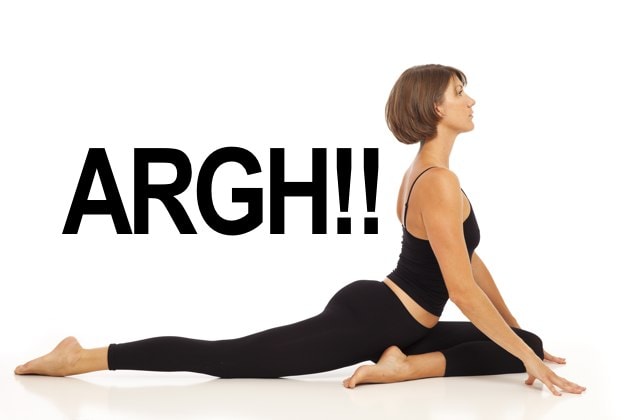
There is a fine line between love and hate in life and in yoga. On our yoga mat, we encounter poses that we love as well as poses that we, dare I say it… hate. Yes, hate is a strong word, but for many of us, there are poses we tend to avoid or, as I wrote in another column, the poses that we did not love at first sight. I’ve witnessed and experienced my share of these less than lovable poses in my years as a student and as a teacher. Here are some common offenders, in no particular order, along with a few ways to help change hate to love.
1. Pigeon Pose (Eka Pada Rajakapotasana)
Why You Hate It
 Let’s face it. Most hip openers like Pigeon pose can get our ire up. Our hips typically stabilize us as we move; however, they are not prone to being extraordinarily flexible. On top of that, we’re no longer the hunting and gathering types, so our movements tend to be rather limited as well.
Much of our day might be spent sitting and even the most common exercises don’t always encourage us to use a full range of motion in our hips. So a pose like Pigeon, which asks for external rotation in the front leg while maintaining internal rotation on the back leg, is not necessarily what someone with tight, inflexible hips would consider heaven.
How You Can Learn To Love It
In spite of the initial discomfort, Pigeon and most hip openers offer a pathway to begin unlocking the tightness to develop more mobility with alternative movements other than the actions needed for walking or sitting. But this can’t be achieved through force or pushing. Hip openers respond better when we surrender to what is.
Next time you’re faced with this pose, practice patience and compassion towards yourself. Rather than gritting your teeth or tensing in resistance, try for some calming breaths so you can ease into whatever level of the pose is possible. Remember this doesn’t always have to be the full expression; you can use props like blocks or blankets to support you or modify the pose to get similar benefits without risking injury.

2. Boat Pose (Navasana)
Why You Hate It
 Boat pose – This classic abdominal strengthener requires a lot of initial strength and core stabilization to perform it comfortably. If you lose core integration, your back can get the brunt of the strain, which no longer brings a smile to your face.
How You Can Learn To Love It
For core work, it doesn’t pay to push yourself beyond your limits too soon. If you try to muscle the pose, you risk learning bad habits or injuring yourself. So if you tend to strain in Boat, it is better to back off to a more accessible level of the pose in favor of building your strength.
In the pose, consider keeping the knees bent so the shins are parallel to the floor. Your hands can lightly grasp behind your thighs to help stabilize as well as help maintain lift through the chest to reduce straining your back. When you can comfortably hold the pose for several breaths this way, experiment with letting your hands move away from your legs while still maintaining a long spine.
It might take some time, but when you tune in to your body’s true capabilities, you’ll cultivate a lot more power than if you push yourself too quickly.
3. Extended Hand-to-Big-Toe Pose (Utthita Hasta Padangustasana)
Why You Hate It
 Standing poses that add in balance tend to get groans or hard stares in my classes. These poses can be difficult to sustain gracefully for more than a few breaths. Poses like this show you how grounded and involved your feet truly are; as soon as you take one foot away, it’s a whole other story to maintain your balance.
Chalk it up to an innate fear of falling, but wobbling in standing poses like this can make you feel like you’re losing control, which sucks.
How You Can Learn To Love It
Practicing patience is no surprise. Also channeling a bit from the Karate Kid can’t hurt (master the flying crane kick). If you sway in this pose, bend your standing leg to offer a moment to organize your body in the pose and cultivate more grounding. Once you feel stable, you can work towards firming and straightening the standing leg.
Keep your hips stable and level with one another and breathe as calmly as you can. Gaze points can also be remarkably helpful, so keep your gaze fixed on an unmoving object ahead of you to help foster stillness. As soon as you comfortably do this pose, don’t be surprised if you feel like you can try just about anything. You’ll learn to more fully go with the flow, even when both feet aren’t planted!
4. Standing Forward Bend (Uttanasana)
Why You Hate It
 This might not seem like a hateful pose for many, but touching your toes requires a good deal of flexibility that doesn’t always come easily to every body. In fact, this is usually the number one reason I hear why people think yoga isn’t for them.
Tight hamstrings, tight lower back, and tight hip flexors can often get in the way of enjoying forward bends. And if you have to do it several times, as you do in a typical Vinyasa or Ashtanga practice, it can feel especially frustrating.
How You Can Learn To Love It
Treat forward bends like a rest period. Similar to hip openers, it’s better to surrender to what you can do instead of muscling your way toward injury. Oftentimes, bending your knees slightly can give you just enough opportunity to gradually lengthen the hamstrings and release tension in the lower back, which can help you deepen into your forward bend more safely.
It is also important to hinge at the hips rather than bend at the waist, which will lessen the stress to your lower back, the lumber spine. Allow your body time to deepen into forward bends so you can truly sigh with bliss rather than with defeat.
5. Bow Pose (Dhanurasana)
Why You Hate It
 Whether you’re struggling to get your hands to your ankles or your back is feeling that nasty crunch, this is a tricky pose. It requires a potent cocktail of determination, openness and luck, in addition to a flexible spine, open shoulders, and strong legs. Sometimes those ingredients are hard to come by all at once.
How You Can Learn To Love It
Pay attention to the different elements in the pose. It’s not just about the back bending; your legs, arms and breath can be incredibly helpful in a pose like this, too. If you cannot comfortably grab your ankles, then reach back without clasping and focus on lifting up behind the heart.
Keep your shoulders rolling down and back, like in Cobra pose (Bhujangasana), and keep your tailbone long to avoid compressing your lower back. Focus on gently grounding your pelvis and thighs to distribute the back bending to your upper back, the thoracic spine. If tension is brewing in parts of your body, direct some freeing breaths to those areas. This can be a way to release the tightness long enough to find some comfort in the pose.
Here’s to the hope that these poses become more loveable someday!